


 English

What a Heating Pad for Cramps Actually Does
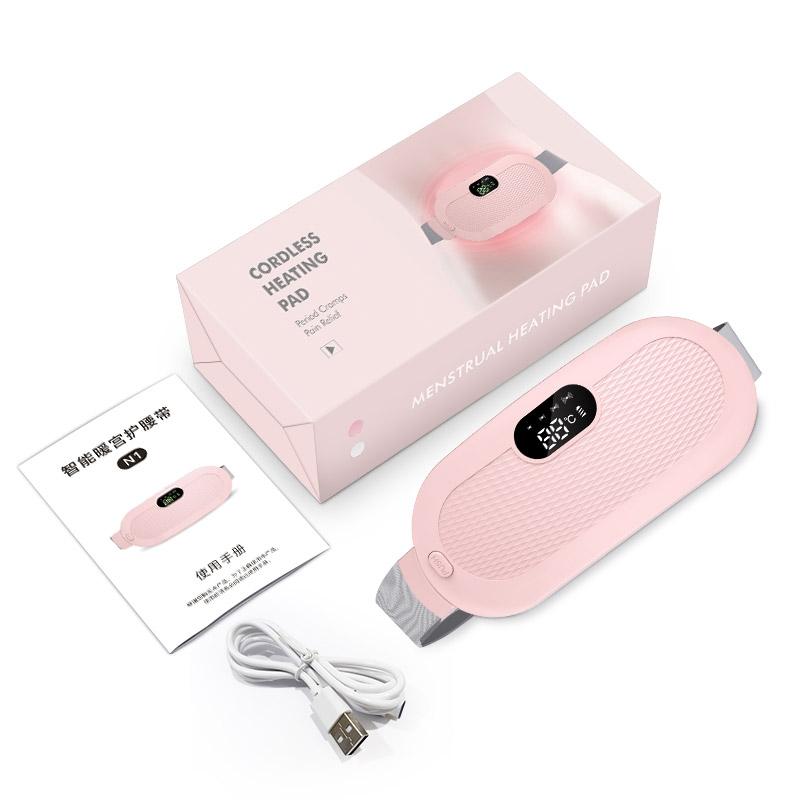
A cordless Warming Belt holds steady heat against the lower abdomen, where period cramps are felt.
A heating pad for cramps is a heat source you place on the lower abdomen during a period. It eases pain because steady warmth at roughly 40–45°C relaxes the uterine muscle and increases local blood flow, so the cramping settles instead of building up. A good menstrual heating pad holds that temperature evenly for 30–60 minutes without ever getting hot enough to burn, which is why cordless, wearable pads have largely replaced hot water bottles for period pain.
This guide covers how heat works on period cramps, the three main types of heating pad on the market, and the details worth checking before you buy one — whether it is for personal use or for a brand you are sourcing for.
How Heat Relieves Menstrual Cramps
Period cramps come from the uterus contracting to shed its lining. The contractions squeeze blood vessels, which briefly starves the muscle of oxygen and produces the familiar dull ache. Heat interrupts that loop in two ways: it relaxes the muscle fibres so they contract less forcefully, and it widens the blood vessels so oxygen reaches the tissue again. The result is relief that starts within a few minutes and lasts as long as the warmth is applied.
Continuous low-level heat is well studied for this. Clinical reviews have found that a heat patch delivering about 40°C to the lower abdomen can reduce menstrual pain to a similar degree as a standard dose of ibuprofen, and combining the two works better than either alone. That is the reason a heating pad for period cramps is treated as a first-line home remedy rather than a comfort gimmick.
If your pain is not settling with heat and over-the-counter painkillers, or if it is getting worse cycle after cycle, that is a conversation for a doctor rather than a product decision — severe period pain can point to conditions such as endometriosis or fibroids.
Types of Heating Pads for Cramps
There are three practical options, and they differ in how you power them, how long they last and how much they cost over a year.
Cordless, Rechargeable Heating Pads
A cordless heating pad — also sold as a wireless heating pad or wearable heating pad — runs on a built-in lithium battery and is worn against the skin with a belt or elastic strap. You can walk, work or sleep with it on, which is the whole point. Most models offer several temperature steps (typically 40–60°C) and an auto shut-off timer. A rechargeable heating pad with a 1,800–2,000 mAh battery usually runs for two to four hours on a mid setting, and recharges over USB-C in about three hours.
Plug-In Electric Heating Pads
These are the classic pads you plug into a wall socket and lay across the lap or abdomen. They are inexpensive and give large, even heat, but the cable anchors you to one spot, so they are best for lying down at home rather than for use on the move. They are also the type most often implicated in burns, because it is easy to fall asleep on a high setting.
Disposable Heat Patches
A heat patch is a thin, air-activated pad you stick to the inside of your underwear. It warms to about 40°C for up to eight hours and is thrown away afterwards. Patches are the most discreet option and need no charging, but they are single-use, so the cost adds up month after month, and the temperature cannot be adjusted.
Heating Belts and Wrap-Around Pads
A Warming Belt combines a curved heating surface with a strap that wraps around the waist. Because it hugs the body, an abdominal heating pad or wrap-around heating pad keeps contact with the lower abdomen even when you move, and many add gentle vibration massage to help the heat feel deeper. This is the format most period heating pad and menstrual heating pad models now take.
Cordless vs Plug-In vs Heat Patch: A Quick Comparison
| Type | Power | Wearable? | Reusable? | Best for |
|---|---|---|---|---|
| Cordless / rechargeable | USB-C battery | Yes | Yes | Work, travel, sleeping, daily use |
| Plug-in electric | Mains cable | No | Yes | Lying down at home, large area coverage |
| Disposable heat patch | Air-activated | Yes | No | Discreet daytime use, no charging |
What to Look For in a Menstrual Heating Pad
If you are choosing a heating pad for period cramps, these are the features that decide whether you will still be using it a year from now.
- Adjustable temperature, not just on/off. Four or five steps in the 40–60°C range let you use gentle heat for all-day wear and stronger heat for the worst hours.
- A real thermostat. NTC constant-temperature control keeps the surface steady instead of drifting hotter the longer it runs — the single most important safety feature.
- Battery life and charging. Look for at least 1,800 mAh and USB-C charging, so you are not hunting for a proprietary cable.
- Fit and shape. A curved, low-profile pad sits flat against the abdomen without digging in, and stays put when you stand up or turn over.
- Vibration massage. Adjustable vibration levels mimic a light hand massage and make the heat feel deeper, which many users find helps the ache more than heat alone.
- Auto shut-off. A timer that powers the pad down after a set period is essential if you tend to doze off with it on.
- Weight and noise. A pad around 150 g is light enough to forget you are wearing it; a quiet vibration motor means you can use it at a desk or in bed.
How to Use a Heating Pad for Cramps Safely
Heat is safe when it is controlled. A few habits keep it that way:
- Start at the lowest setting and move up only if you need to. Comfortable warmth, not heat you have to endure, is the target.
- Keep sessions to about 20–30 minutes at a time, and check the skin underneath every so often.
- Never use a heating pad on broken, numb or insensitive skin, and be extra careful with reduced sensation (for example with diabetes or nerve damage), where you may not feel a burn developing.
- Do not fall asleep on a high setting. If you want overnight heat, choose a cordless pad with an auto shut-off.
- Heat is not a substitute for medical care if the pain is severe, sudden or unusual for you.
Which Heating Pad Fits Which Need
The same pad can serve more than one purpose, but the priority shifts with the problem:
- Period cramps: for everyday use a heating pad for cramps should be cordless, curved and adjustable — a period heat pad you can wear through a workday without a cable.
- Menstrual back pain: look for a belt long enough to wrap the lower back as well as the abdomen, so a heating pad for period back pain can be turned around when the ache moves.
- Endometriosis: an endometriosis heating pad needs a wide, flexible surface and gentle, sustained warmth rather than high peak temperatures, since pain often lasts for hours.
- Pelvic pain: a heating pad for pelvic pain works best when it sits low and flat across the pelvis; a rigid pad will not follow the curve.
- Stomach cramps and belly ache: a heating pad for stomach cramps and a belly heating pad both do best on a lower, softer setting — there is no benefit to turning the temperature up.
- General menstrual pain: if you want one device to serve as a heating pad for menstrual cramps and for everyday heating pad for menstrual pain, choose the widest adjustable model you can find.
- Ovulation pain: short sessions of mild heat on the side that aches, rather than continuous high heat.
Sourcing Heating Pads for Your Brand
If you are a brand, distributor or retailer rather than an end user, the buying decision moves from features to supply. The questions that matter are who actually builds the pad, what can be customised, and what evidence comes with it.
A working cordless warming belt is a small electromechanical device: a PI or graphene heating film, an NTC thermostat, a lithium cell with a protection board, a vibration motor and a control PCB. Because it is built rather than assembled from shelf parts, the OEM has room to change the temperature range, the intensity steps, the shell colour, the logo and the retail packaging without changing the tooling — which is what makes private-label projects realistic at moderate order volumes.
Before you commit to a supplier, ask for the specification sheet (heating temperature steps, battery capacity, charge time, net weight and carton configuration), a quality inspection report, and a sample you can wear for a full day. Send your target market and quantity to the manufacturer early: compliance route, packaging language and price all depend on it. You can see the full range of warming belt and heat therapy devices we build, or send your spec for a quote and a sample timeline.
FAQ
Does a heating pad help with cramps?
Yes. Continuous low-level heat on the lower abdomen relaxes the uterine muscle and improves blood flow, and studies show a heat pad for cramps can reduce period pain to a similar degree as ibuprofen. It works best applied early, before the pain peaks.
How long should you use a heating pad for period cramps?
Sessions of about 20–30 minutes are typical, repeated as needed through the day. A rechargeable pad with two to four hours of battery life will usually cover a full workday or a night’s sleep on a low setting.
What temperature is safe for a heating pad?
Around 40–45°C is the comfortable, effective range for period pain. Many menstrual heating pads go up to 60°C for short bursts, but that should be a temporary setting, not the one you leave running.
Can you sleep with a heating pad on?
Only with a cordless pad that has an auto shut-off, and only on a low setting. Never sleep on a plug-in electric pad, and never on the highest setting.
Is a heating pad or a heat patch better?
A heat patch is cheaper per use and fully discreet, but it is disposable and fixed at one temperature. A cordless heating pad costs more up front, gives you adjustable heat and vibration, and lasts for years — so it usually wins for anyone with regular cramps.
Are cordless heating pads worth it?
For period cramps, yes. The freedom to keep it on while you move around, plus adjustable temperature and a timer, is what makes a portable heating pad genuinely usable rather than something you only reach for when you are already lying down.
Conclusion
A heating pad for cramps works because steady warmth relaxes the muscle that is causing the pain and restores blood flow to it. For most people the most useful format is a cordless, rechargeable pad with adjustable temperature, a real thermostat, a wrap-around fit and an auto shut-off — and if you are sourcing these for a brand, the specification sheet and quality report matter as much as the feature list. If you would like to see samples or discuss a private-label Warming Belt for your market, get in touch with our team.